By Leena Danpour Gurnick, Esq.
This article first appeared in the CAI-CV HOA Living Magazine, August Edition.
On June 30, 2025, California Governor Gavin Newsom signed AB 130 into law, codified in California Civil Code Sections 5850 and 5855, with immediate effect. This legislation introduces significant changes to how homeowner’s associations (HOAs) may impose fines for violations of their governing documents, aiming to enhance homeowner due process while imposing strict limits on fine amounts.
Below is an outline of the key changes that demand prompt attention from HOA boards and managers.
1. Most Association Fines Are Capped at $100
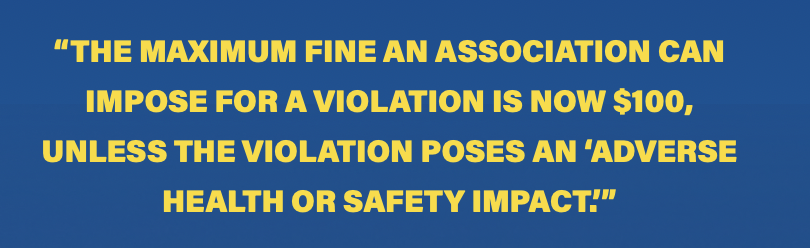
The maximum fine an association can impose for a violation is now $100, unless the violation poses an “adverse health or safety impact.” In such cases, a board may levy a higher penalty than $100 as outlined in the association’s existing Fine Policy, provided the violation could harm the common area or another member’s property. However, before imposing any fine exceeding $100 under this exception, the board must adopt a written finding in an open meeting, detailing the specific health or safety risk without disclosing identifying information about the individual member involved. Additionally, no late charges or interest may be applied to any monetary penalty.
2. Members Will Have an Opportunity to Cure Violations
Prior to imposing any discipline, including fines or suspension of membership privileges if authorized by the governing documents, a board must give the member an opportunity to cure the violation before the disciplinary hearing. If the member cures the violation before the board hearing, or if curing the violation requires more time than the notice period allows and the member demonstrates commitment through measures like a signed contract or paid deposit, no fine or other discipline can be imposed.
Furthermore, if the board and member disagree following the hearing, the member may request internal dispute resolution (IDR) under Civil Code Section 5910. Alternatively, if an agreement is reached, the board must prepare a written resolution, signed by both parties, documenting the outcome.
3. Shortened Notification of Board Decisions
Boards must now provide written notification of hearing decisions within 14 days (reduced from 15 days) after the board’s action.
What Does AB 130 Mean for Associations?
AB 130 will likely shift the way associations traditionally enforce their governing documents and result in more structured and individualized enforcement measures, less focused on levying fines, and more focused on non-monetary remedies or legal action.
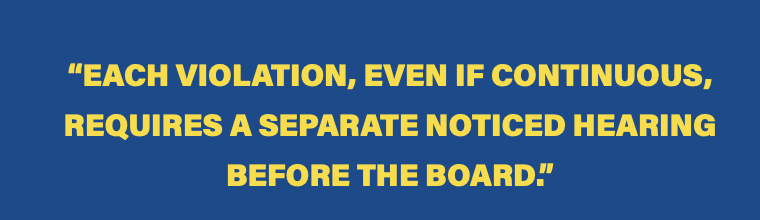
Since members now have the opportunity to cure violations before the board hearing, levying daily or monthly fines for continuing violations, after noticed hearing before the board, is no longer permissible.
For larger or ongoing violations that do not qualify as an “adverse health or safety impact” and remain uncured, associations will likely offer mediation and/or pursue lawsuits to seek court ordered injunctions for enforcement, as a $100 fine will likely fail to result in compliance. Associations should also anticipate a rise in IDR requests from owners seeking to challenge board hearing decisions.
Although this shift will likely increase the administrative workload and/or legal fees, it will also give opportunities to boards to work with their legal counsel to come up with creative solutions that may be more effective than standard fines. The resulting shift in an association’s approach to enforcement will still allow Boards to continue to hold members accountable and even prevent members from committing minor violations (such as landscaping overgrowth, parking infractions, or improper storage of trash bins), potentially in a more effective manner.
While some may view this new law as a victory for members due to reduced fine amounts, it is likely to result in an increase in IDRs, mediations, and lawsuit. These formal enforcement mechanisms will drive up legal expenses, which members may bear collectively through special assessments or higher regular dues. Accordingly, Boards should consider adjusting their budgets to account for increased legal expenditures and proactively consult legal counsel when developing or revising their enforcement policies.

Next Steps the Association Should Take
Association boards are encouraged to work with legal counsel to review their governing documents, including their current enforcement policies and fine schedules in light of AB 130. Updating these documents can help to ensure clarity and consistency with the new statutory framework. Boards
may also explore alternative enforcement tools with legal counsel, as alternatives to fines can still promote compliance without relying solely on monetary deterrents. Creative, tailored enforcement strategies are more important than ever under this new legal shift.
AB 130 does not eliminate the board’s enforcement authority; it simply requires that it be exercised with more structure and care. For ongoing or repeated violations that are not health and safety risks, legal action, such as mediation or a court injunction, may now be the most effective tool to secure compliance.

Ultimately, while AB 130 may reduce the reliance on fines, it reinforces the importance of legal oversight in enforcement. Associations should view this as an opportunity to refine their procedures and consult legal counsel on best practices moving forward.
Finally, stay vigilant for any future amendments to this law as it is very new and will likely evolve.